

Fighting ICE, feeding the poor and bearing arms is attracting donors and members
By Christian Barnes
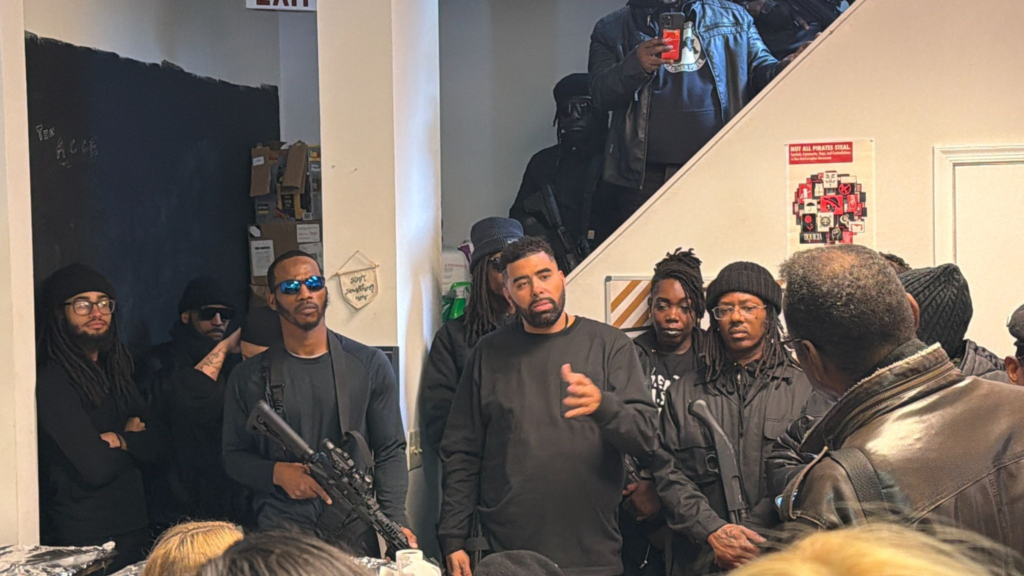
On a cold winter morning, over 100 people squeezed into a narrow North Philadelphia rowhouse, while over two dozen others stood patiently in line outside.
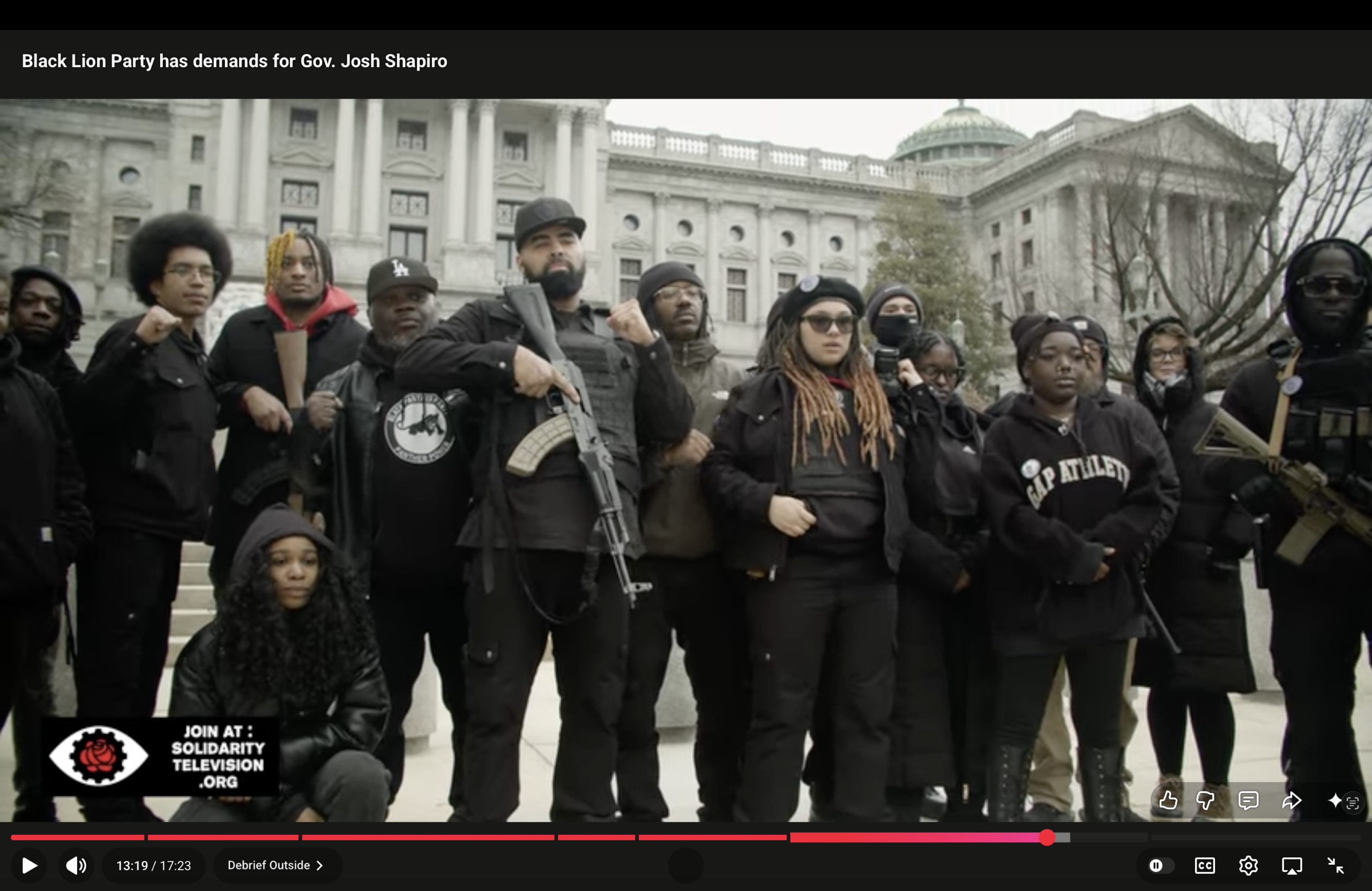
Inside, six armed men in military garb stood in the front of the living room around Paul Birdsong, the national chairman of the new Black Lion Party for Self Defense and International Solidarity.
”Right now, this world is governed, manipulated, and exploited by white supremacy,” Birdsong, 39, said.“United, we can change that; divided, they will continue to defeat us. The time is now.”
The group went mostly unnoticed until a video of Birdsong and other members of the party confronting Immigration and Customs Enforcement (ICE) agents in the Fairhill neighborhood of Philadelphia went viral on social media in early January. It garnered widespread support and donations for the group across various fundraising accounts.
“I don’t care what these ICE, Nazi agents have, because I know my comrades and I are trained,” Birdsong said during a March Instagram Live. “All that fancy equipment is useless when a hollow point 7.62 is going through your armor.”
With images of ICE agents violently clashing with protesters in Minnesota and President Donald Trump demanding mass arrests of undocumented people, Birdsong’s message has found an audience — fueled by viral confrontations and growing anxiety in neighborhoods battling crime and food insecurity in North and West Philadelphia.
“People are angry,” said Linn Washington, a Temple University journalism professor and investigative reporter. “At times of instability, people are going to attach themselves to these ideas, especially the young folks.”
The Black Lion Party was modeled after the Black Panther Party for Self-Defense, which began in Oakland, California, in 1966. The Panthers became well known for armed patrols monitoring police activity amidst segregation and targeted attacks against African-Americans. But the Panthers also created a network of community “survival programs” including free breakfasts, health clinics, and education projects, helping meet the basic needs of people in disenfranchised neighborhoods.
Nearly a fifth of Black and Hispanic households in North and West Philadelphia face food insecurity, defined as a lack of access to enough food for a healthy life, according to a 2025 report from Philadelphia City Council’s Food and Nutrition Security Task Force.
“When social programs fall short, the people step up; that’s what the Panthers always did,” Washington said. “They were always operating around us. We just have more technology now. Anyone can claim the nobility of the Panthers without embodying that code or spirit.”
Birdsong called his group a chapter of the Black Panthers, but he has since disavowed the original name. Founding members of the Black Panthers withdrew their support because of his verbal attacks against law enforcement. Myesiha Newton filed a cease and desist order on the group’s use of the Panther title in early January, alleging defamation.
“That name betrayed me,” Birdsong said. “I find it offensive now, after all the work I put in. But we’re doing our own thing here. We don’t need the name. We don’t need anyone’s permission. A lion is stronger than a panther anyway.”
The Lions have gained rapid visibility in recent months, driven by social media campaigns showing members distributing food, handing out supplies, and patrolling neighborhoods while openly carrying high-grade firearms.
This comes amid a broader rise in gun ownership in Philadelphia, where the city issued more than 52,000 new license-to-carry permits in 2021, a more than 600% increase from the year prior. Nationally, researchers have also documented a surge in militia and paramilitary activity, with the Southern Poverty Law Center reporting that the number of anti-government militia groups grew in the years following 2020, reflecting a wider expansion of organized, armed movements across the United States.
“You don’t have to like me, a lot of folks don’t,” Birdsong said. “I get at least two people hitting me up every day to say something, to threaten me, or call me a fraud. That’s not going to stop anything. If you have an issue, we can fight out back.”
Despite mixed reviews online, some local communities are receptive to the party and its aid operations.
“People are relying on these institutions for their needs,” Washington said. “While the message may be controversial, the basic needs are real; survival often outweighs ideology, that’s why we see so much support early on.”
In early March, the group held a food drive at its new West Philadelphia headquarters. Members surrounded tables of food and clothing, armed with AK-style rifles, shotguns, and holstered handguns.
“I wouldn’t know what to do without these guys,” said Angie Gomez, 71, of Cobb’s Creek, who frequents the Lions’ food drives. “It’s almost impossible to get fruits out here. I can barely afford the bus as it is.”
The party posts activities on their Instagram and TikTok pages, encouraging donations and word-of-mouth advertising. Fundraising efforts have soared.
The group has received approximately $ 78,000 from hundreds of donors over the last six months through fundraising websites such as GoFundMe and Kickstarter, with Birdsong claiming all proceeds go back into funding the group’s activities and aid events.
“Yeah, it’s a lot of money, but we got it over time, that’s what people don’t understand,” Birdsong said. “And it all goes back into our mission, we’re able to pay comrades’ rent who are out here protecting the community, every day, we’re able to give out food and clothes.”
The Black Lion Party has united groups from New York, Maryland, New Jersey, and Michigan under the “Black Lion” banner.
“We got brothers in New York, we got brothers in Jersey, Maryland, I even have people out in LA trying to network,” Birdsong said. “If we all could communicate together, train together, learn together, fight oppression together, we can really do something here.”
On social media, the party displays heavy firepower and a willingness to act, while maintaining that their guns are strictly for defense purposes.
“We’ll never be the ones starting anything, but we’re going to defend ourselves, defend each other, a pig’s biggest fear is a black man with a gun,” Birdsong said. “You’re not going to see any of my comrades without a big-ass gun.”
This visibility comes as firearms already shape daily life in Philadelphia, particularly in predominantly Black neighborhoods across North and West Philadelphia. African-American residents make up the vast majority of both shooting victims and those arrested in connection with shootings, with 80% of firearm arrests since 2015 being tied to black residents, according to the city’s 100 Shooting Review Committee Report from 2022.
Sarah Margioni, 38, of Spruce Hill, often sees the Lion’s patrols around the neighborhood. She said there are already too many guns in the city.
“I never felt safe around them [firearms], and my family never felt safe around them,” she said. “I think it’s just going to bring more problems.”
The Philadelphia Police Department declined to comment on the Lions and their operations.
Philadelphia Police revoked Birdsong and three other members’ license to carry a firearm on the grounds of “bad character” after a raid by police on the former headquarters in February. Still, the group continues to conduct armed patrols, posting their activities on Instagram and TikTok, while receiving financial support from donors worldwide.
“It’s unify or die at this point,” Birdsong said.
Published April 27, 2026
Comments