

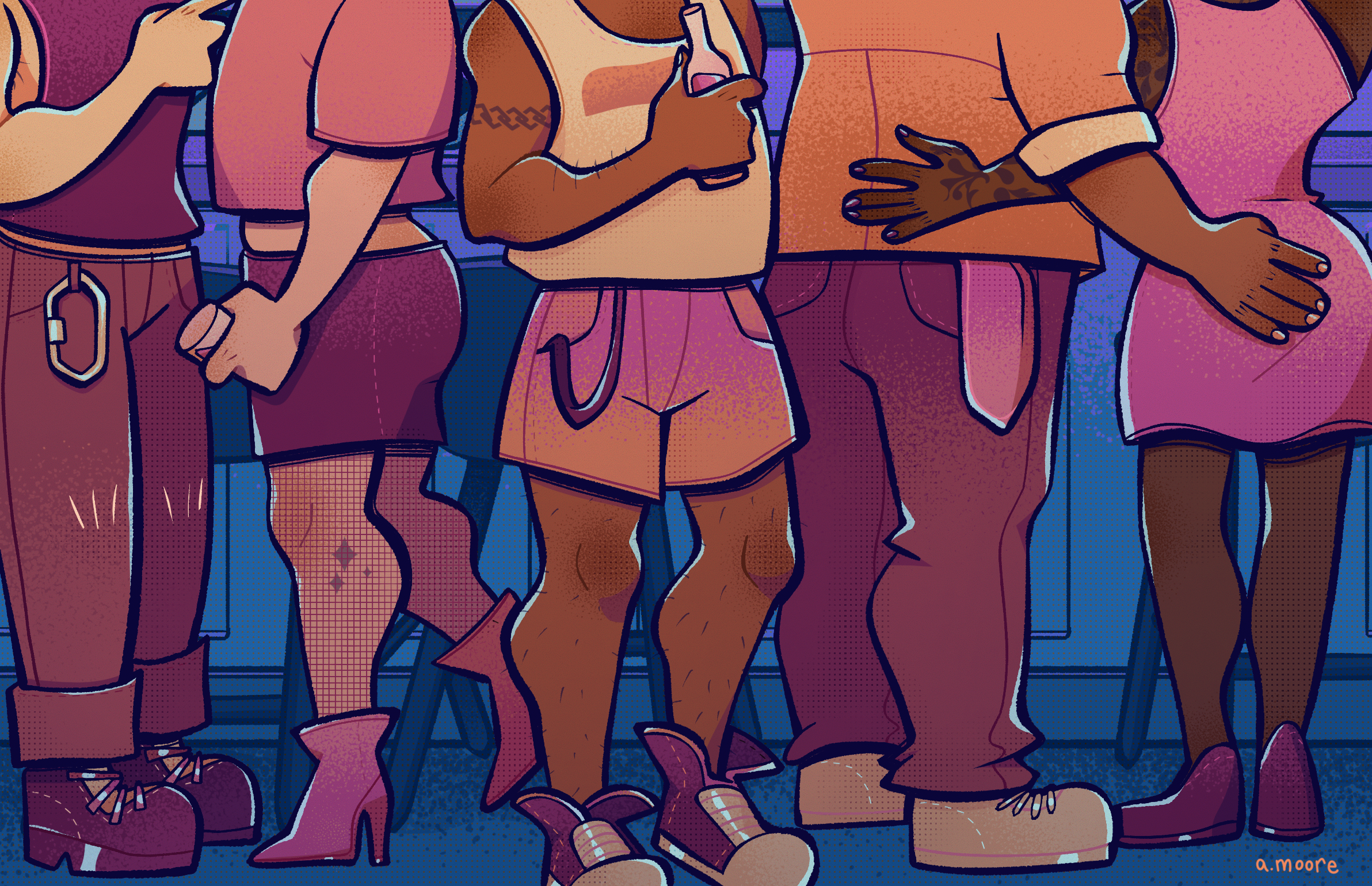
Philadelphia joins the list of cities reviving the nightlife scene for queer women.
by Ashlee Moore
Illustration by Ashlee Moore
Patrons file into a nondescript bar where a tall doorwoman greets them with “baby” as she scans IDs under a black light before ushering them into a pink room. It may seem like a familiar scene on South Street, though the kitschy mirrors belong more in Versailles than Philadelphia.
Inside, the music is low and the drinks are named things like “Butch Bait” and “My Ex-GF Is Here!” The crowd—everyone from tatted soft femmes and goth studs to the gender ambiguous and non-conforming—fills the first-floor space with intimate conversation just an hour after the bar’s grand Wednesday night opening in March.
By nightfall, the dance floor upstairs will be packed at Val’s Lesbian Bar, one of a small but growing number of queer spaces for women opening across Philadelphia after decades of decline. For queer women and nonbinary people, these bars were among the few physical spaces built specifically around their identities.
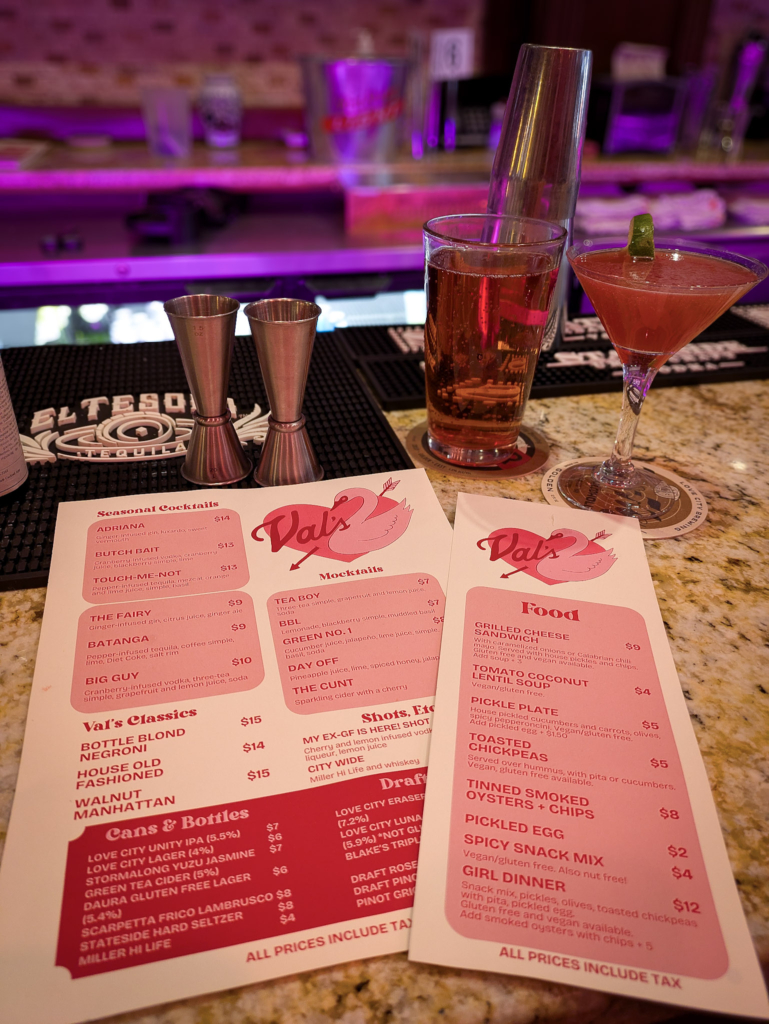
The drink and food menus at Val’s Lesbian Bar | Photo by Jen Appell
In the 1980s, there were an estimated 200 lesbian bars across the United States after queer women found themselves sidelined in the male-dominated gay bar scene. By 2020, fewer than two dozen remained, a dramatic decline documented by efforts like The Lesbian Bar Project, an advocacy initiative launched to raise awareness and direct funding toward the few surviving bars.
Today, there are nearly 40 lesbian bars across the United States, a number that’s tripled from 2020. Julia Harris began dreaming up the idea for Val’s while living in Boston around that time.
“I was really missing my queer Philly community during pandemic lockdown,” Harris, one of the bar’s co-founders, said. “I was yearning for a new space that could bring all my friends and the wider community together.”
The urgency behind the project has evolved since then. As political attacks targeting queer communities—especially transgender people—have intensified nationwide, creating a physical gathering space took on greater significance for her and her partner, Harris said.
“We’re seeing really gravely escalating threats to queer and especially trans communities, as well as many other marginalized groups,” she said. “It’s only strengthened my desire to create a place where people can feel connected and at home.”
Chatting at a corner table with her roommate, Amanda Khu said queer bars for women feel different compared to mainstream nightlife spots.
“It’s easiest to just be at ease and be myself in a place that’s directly meant for me,” said Khu, who recently moved to Philadelphia.
Philadelphia’s lost lesbian bar scene
The reasons for the disappearance of lesbian bars are complex, but economically, these spaces had a disadvantage from the start: Their target demographic tends to earn less and have more responsibilities at home.
“The margins are thinner for women bars because women make less money,” said Timaree Schmit, a Philadelphia-based sexologist, educator, and former performer and producer at Sisters Nightclub, a lesbian club and restaurant which closed in 2013. “They have less disposable income and are more likely to have responsibilities that keep them from staying out drinking all night.”
Queer bars have historically been fragile institutions even under ideal conditions, said Bob Skiba, curator of the William Way LGBT Community Center‘s John J. Wilcox, Jr. Archives.
“It’s not unusual for queer bars to come and go,” said Skiba. “But [we were] losing women’s bars at a real alarming rate.”
Skiba cited gentrification in the late 20th and early 21st centuries, which reshaped the urban neighborhoods where many lesbian bars once thrived, as a reason for their closure. Across cities like New York, San Francisco, and Washington, D.C., long-standing venues closed as rent prices climbed and communities were displaced.
Cultural shifts also played a role. As queer acceptance increased, queer women were no longer restricted to patronizing a handful of dedicated spaces, Skiba said. Many began socializing in mixed-gender or mainstream venues, while dating apps and social media reduced the need for physical meeting places.
The economics of queer nightlife favored spaces for gay men, said researcher and performer Chloe Davis. Those venues usually benefited from larger audiences, greater investment, and stronger financial networks. Lesbian bars, serving a smaller, historically less affluent customer base, struggled to compete.
Philadelphia followed this national pattern. Once home to multiple lesbian bars, those cultural and social hubs gradually disappeared. Sisters closed in 2013. Toasted Walnut followed in 2021, marking the loss of Philadelphia’s brick-and-mortar spaces for queer women.
The loss of Sisters was a turning point for Schmit, who “didn’t have another spot” after the bar’s closure.
“I really thought that was the end,” she said. “I didn’t feel the same way about going to other gay bars that cater to men, and straight places did not seem like a viable option either… It was pretty devastating.”
Created by Colin Evans with data from Bob Skiba/John J. Wilcox, Jr. Archives at William Way LGBT Community Center
‘Most at home’
The return of lesbian bars has been fueled in part by the connectedness of the queer community online. Owners have built social media followings before opening their doors using crowdfunding campaigns, viral posts, and event-based fundraising to generate financial support and visibility.
But challenges remain for owners. Even with grassroots support online, it took nearly two years to find the right location for Val’s within budget, a process complicated by exploitative landlords, Harris said.
Financing was another major hurdle. In Pennsylvania, liquor licenses can cost hundreds of thousands of dollars, forcing Val’s founders—first-time business owners—to cobble together loans, fundraising events, and community support.
Newer queer spaces also face the challenge of surviving the expectations of a community that is deeply invested in them but unforgiving when they fall short. Bad press “can be a death knell” for small businesses today, Schmit said.
Marsha’s, a queer women’s sports bar that opened in 2025, is facing backlash on social media after a former bartender alleged she was harassed by the bar’s general manager. The bartender’s initial TikTok post has more than 100,000 views and has sparked a social media campaign demanding accountability from the owner, Chivonn Anderson.
Skiba is cautious to say whether lesbian bars are coming back.
“I’m not sure there’s a resurgence yet,” he said. “It’s just beginning.”
He does, however, see something historic in the current moment. In the past, people assumed women’s spaces would always exist, but now, there’s a conscious effort to save them.
Spaces like Val’s offer a safer nightlife option, said Nia Ashby, a patron at the grand opening.
“I get hit on a lot by men, and sometimes those situations can be very uncomfortable with how persistent they can be,” Ashby said. “I have a separate Google Voice phone number that I will give out to men because sometimes they will not take no for an answer. Removing those men from the equation means I don’t need to be on guard the entire time.”
For patrons like Khu, she feels “most at home” in bars like Val’s.
“If this space wasn’t here, I don’t know what I would turn to,” Khu said. “There’s other sapphic nightlife, but it’s very pop-up centered. To have a place that is permanent and established just feels like the lesbian community can be rooted here.”
Click here to read The History of Queer Nightlife
Published April 29, 2026
Comments