

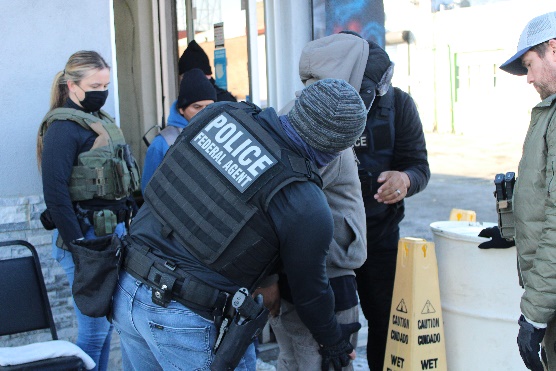
Nearly a third of the city’s estimated 47,000 undocumented immigrants have at least one child under 18
By Gianna Voges
Julia hasn’t slept well in months.
She spends every moment worrying her Ecuadorian parents won’t come home from work. If they were deported, she would be forced to drop out of college and take care of her younger siblings, all while fearing her parents will die before she can see them again.
“I would be lying if I said I was handling it well,” said Julia, who did not give her real name because of her family’s pending asylum case. “I try to stay home as much as possible.”
At least 3,743 people in Philadelphia have been deported since Donald Trump’s inauguration, according to the Deportation Data Project, and the culture of fear extends to the estimated 47,000 undocumented immigrants living in the city, nearly a third of who have at least one child under 18. Those children, many of whom are U.S. citizens, worry about what happens if and when their parents are removed and they’re left to take care of themselves.
Julia has already seen this happen to her family. On the Fourth of July, her uncle was detained by Immigration and Customs Enforcement (ICE) driving to church, leaving his wife stranded on the side of the highway.
Julia has spent most of her life fearful of these moments. As a toddler, she heard stories of children being left by themselves while their parents were taken away by immigration officers during the Obama administration. Julia learned early on to not open the door for anyone or talk about her parents’ immigration status in school.
“I was worried at a really young age,” said Julia. “I don’t think I should have been worried about that.”
There’s no doubt that separation from a parent is a negative experience for a child. But deportation specifically can amplify these effects, explained Carolina Villamil Grest, an assistant professor of social work at Temple University. The child may not comprehend what’s going on, and it can take days, weeks or even months to find out where the parent is located after being detained.
“It’s an adverse childhood experience, it does create adversity,” said Villamil Grest. “It’s something akin to the loss of a parent, but it is its own structure of trauma. It is its own kind of trauma.”
Oscar, whose family also faces threat of deportation, is fearful for what will happen to his younger siblings if his parents get detained while he’s three hours away at school.
“My parents, my siblings, that’s all we have,” said Oscar, who did not give his real name because his parents are undocumented. “Each other.”
Julia and Oscar’s experiences are shared by many immigrants in the U.S. who have long been preparing themselves for the possibility of deportation, according to a 2024 study of Mexican youth in Los Angeles.
“They remember, very distinctively, being prepared in the event something were to happen. You know, this is where the money is, this is whom you call, etc.,” said Villamil Grest, co-author of the study. “So that’s something that has continued on.”
Oscar said his parents have lived with a constant target on their backs knowing they didn’t have proper documentation to live in the U.S.
“The fear was always there,” Oscar said. “It didn’t matter what president. Whether Obama, Biden or Trump, it didn’t matter because they knew that they were illegal. They knew that at any moment they could be taken away.”
This moment has become more dire for immigrant families, Villamil Grest said, because it is extending beyond undocumented and mixed-status families. There have been reports of ICE agents showing up without warrants and increasing surveillance. In addition, the Supreme Court ruled that racial profiling is grounds for immigration stops, allowing agents to use race as a reason to stop and detain people, including U.S. citizens.
“It doesn’t even matter if you’re in a more blue-leaning state or red-leaning state, in terms of the surveillance, the aggression and the lawlessness of the way enforcement is treating immigrants,” said Villamil Grest.
In Philadelphia, ICE raided a local carwash that led to the arrest of 7 undocumented immigrants this past January.

Officers also detained 90 Central Asian undocumented immigrants – part of a larger effort to remove 130 undocumented residents – in April.
Oscar said his family have continued their daily routines – working to make rent, going to the grocery store, and Oscar continuing his college classes – but are constantly on guard.
“If we let it affect us too much, then we won’t be able to go on with our daily lives,” said Oscar. “I still have things to do. I came all the way to college, I can’t just stop. I’ll continue on, but [the fear] is still there. It’s still in the back of my mind.”
Apart from their work, Julia’s parents have been leaving the house less due to fear of deportation. The family’s sheltering has in particular affected Julia’s youngest brother, who has severe autism and misses riding the bus and subway with his parents.
“We try to explain it to him,” Julia said. “Sometimes he understands and is okay. Sometimes he cries. He gets very emotional. He won’t throw a tantrum, but he’ll cry.”
Julia’s family has been trying to achieve asylum status since 2019, but their trial has been pushed several times and is currently scheduled for 2026.
If Julia’s parents are deported, her mom plans to do everything possible to bring her children with her. But they worry they would not be able to care for Julia’s little brother in their rural Ecuadorian hometown, as before her parents came to the U.S., they had two daughters that died early in life due to a lack of access to proper medical facilities.
The alternative wouldn’t be much better: If she remained in the U.S. after her parents were deported, Julia would trade in her dreams of law school for a full-time job to support her and her two younger brothers
Despite her constant anxiety, Julia keeps moving forward for her parents, motivated by the knowledge they came to the U.S. with nothing and built a successful life for themselves. If they were deported, she knows that they’d want her to not be sorrowful and to continue on their legacy, she said.
“As my parents say, we’re not dead, we’re just moving to another country,” said Julia. “We cry and mourn for the dead, not for the living.”