

Critics say they claim to be convenience stores, but sell drug paraphernalia
By Haddijatou Jammeh
by Haddijatou Jammeh
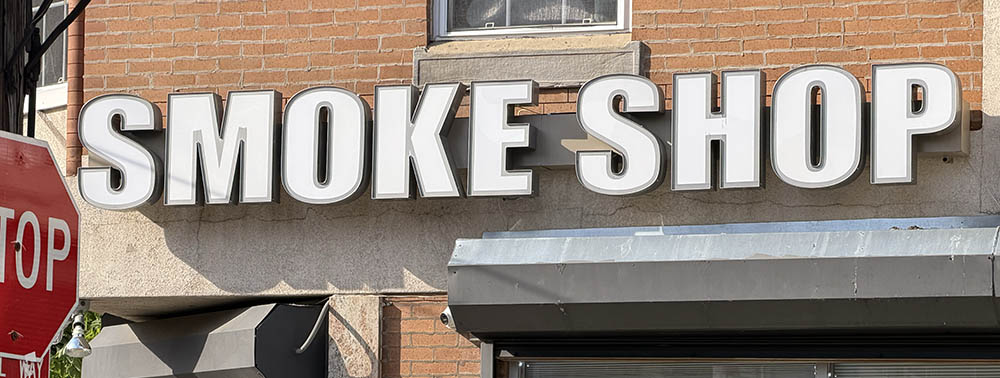
It’s hard to walk down South Street without seeing the flashing lights and rainbow-colored decor of at least a dozen smoke shops, an increasingly common sight not just in Bella Vista but throughout the city.
Rows of rolling papers, bongs, and marijuana products displayed alongside candy, soda, and potato chips fill these stores that have grown in popularity despite recreational marijuana being illegal in Pennsylvania.
Smoke shops have expanded rapidly across Philadelphia, with the city issuing licenses to at least 27 in the past two years, compared to 50 from 2004 to 2022, according to Licenses & Inspections data. Not everyone is happy.
“We have many constituents report that these businesses operate under misleading labels, such as convenience or candy stores, while primarily selling tobacco, drug paraphernalia or related products,” said Taylor Daukaus, the chief of staff for City Councilwoman Katherine Gilmore Richardson.
Bella Vista, which encompasses parts of South Street and the Italian market, home to top tier restaurants and high priced homes, is one of the city’s hotspots for smoke shops, according to the data.
Eugene Desyatnik, president of the Bella Vista Neighborhood Association, said the number of smoke shops in the area is hurting economic growth by preventing other businesses from moving in.
“The sheer quantity depletes available commercial vacancies and depresses the desirability of remaining vacancies by shifting the retail mix on the street,” he said. “Restaurants want to be near other restaurants. Juice bars want to be near pilates studios and saunas. Retail wants to be next to other retail.”
“These shops frequently sell ‘unregulated high’ products like Delta-8, THC-A, and kratom without age checks,” Desyatnik added. “There are no safeguards, no testing, and no ID.”
Philadelphia-area smoke shops sell unregulated products that mislead consumers about using psychedelic drugs with lesser-known health effects, according to an investigation by the Philadelphia Inquirer.
Some smoke shops are also sprouting up near schools, raising the concerns of parents.
“Despite being less than a block from an educational facility, a [smoke shop] is advertising lots of paraphernalia,” Desyatnik said.
Shanae Sutton’s children attend school in Nicetown where there is a smoke shop close by.
“This has been an ongoing argument between me and my kids for the last maybe two to three years. It’s very detrimental,” she said. “There’s been an instance where I had to leave work to go pick up my 15-year-old son, who was at a bus stop hyperventilating and sweating profusely from smoking a vape that he has absolutely no idea of what it contains.”
Immigrant ownership has also been a factor in the growth of smoke shops. Smoke shops proliferated during the pandemic as immigrant entrepreneurs or small grocers looked to replace revenue lost to increasingly strict tobacco sale regulations, according to The Inquirer.
Mohamed, an Indian immigrant, who did not want to give his last name, is a cashier at Amasi Hookah, a smoke shop on Cecil B Moore Ave. The shop, which includes a restaurant and convenience store, primarily sells food, drinks, chips, and candies. Mohamed works the night shift from 12 to 7 AM, seven days a week.
“We check everyone’s ID,” Mohamed said. “We don’t serve anyone underaged. There are two or three smoke shops around here who don’t check ID’s and sell to underage people and we have people complain about it and come here.”
City officials are actively working to address the growing number of smoke shops and the concerns residents have raised about their presence in neighborhoods, Daukaus said. Their office has received many concerns from community members who want stronger oversight of businesses selling intoxicating products, particularly in areas where shops are concentrated or located near schools and residential corridors, she said.
In March, Richardson introduced a bill to establish a license for retailers of “intoxicating substances” that would limit where FDA-approved products can be sold and set an age limit of 21. She also introduced a bill authorizing the city to go after landlords who allow illegal smoke shops to operate. Both bills are in committee.
Andre Cheney, a community engagement manager from the city’s Office of Community Empowerment and Opportunity, said his office hasn’t focused on smoke shops yet, but plans to address them based on his work on the opioid epidemic.
“I have to be honest and say that we haven’t set our sights yet on targeting the smoke shops, but with the work that we’ve done with the overdose response unit and just the opioid epidemic in general, I have to say that is a space that we should eventually move into,” Andre said.
Published on May 5, 2026
Comments